
When inspecting a stormwater culvert, the first question is usually not camera resolution - it's how to get a camera to the defect. For most culvert runs that need remote visual inspection, a K-series sewer inspection robot is the more practical choice; a portable camera is useful for short, easily accessed lines where you need a quick look.
Where a portable camera still earns its place
For CCTV pipe inspection on short pipe runs, small laterals, or dry culverts near an access point, a portable camera - sometimes called a sewer inspection camera robot or drain camera robot - is simple. You set it up, push the camera head through a few metres of the line, and review the image.
Stormwater culverts are rarely that simple. The line may be long, the invert uneven, and water, sediment, and debris common. As a push cable gets longer, it loses stiffness and control. It may not hold position at a joint or follow a bend. Many utility crews keep a portable unit for quick checks and use a crawler for the full condition run.
What K-series crawlers add to the job
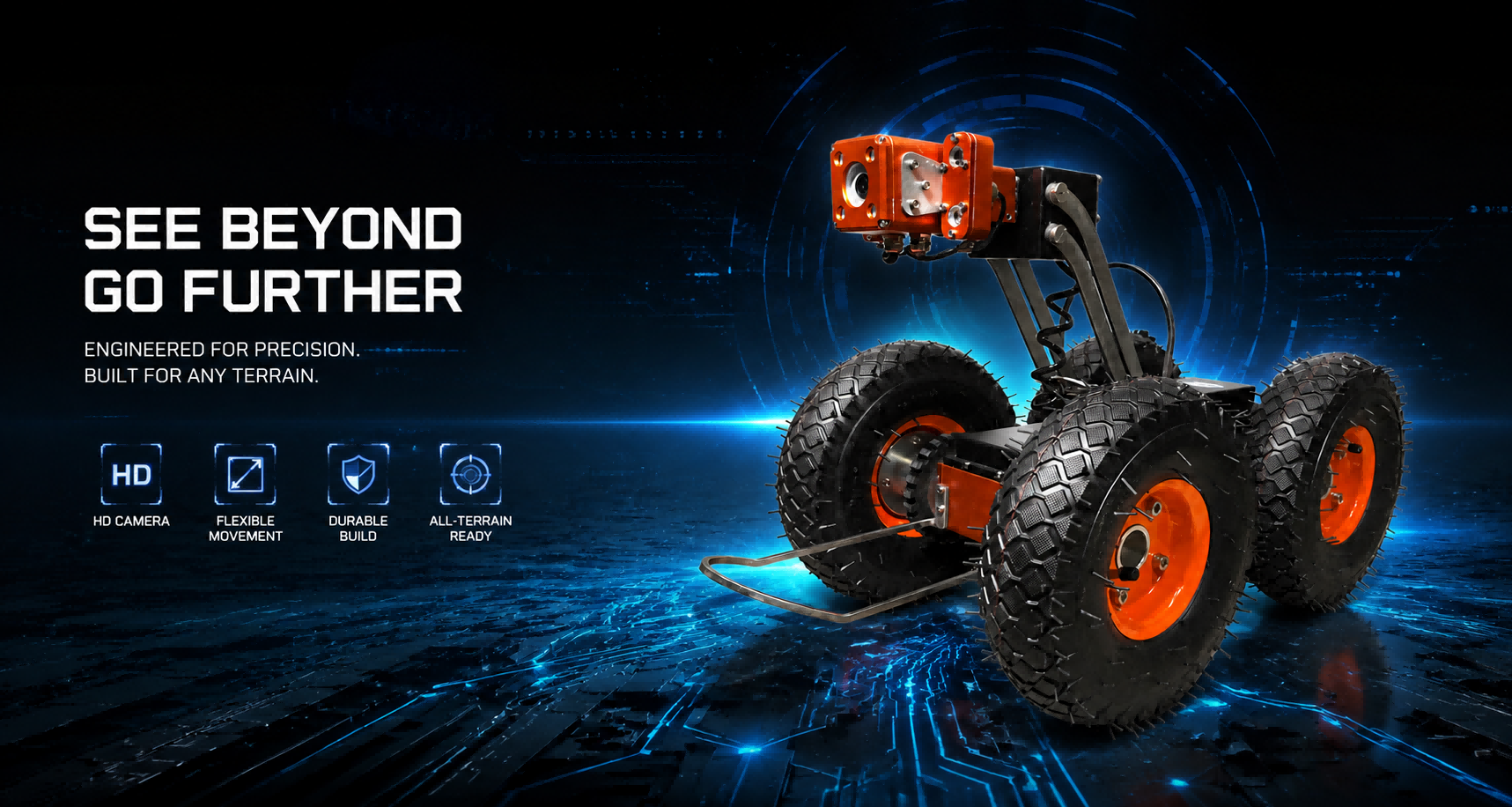
A pipe crawler robot is a tracked vehicle with camera, lighting, cable reel, control end, and recording/report software. It moves under its own traction, so a 360-degree rotation camera can observe the pipe wall and invert. In suitable pipe geometries, this means no confined-space entry is required.
PipeSolv, backed by RJ-BOT (Guangzhou RJ-Bot Industrial Group Co., LTD.) as its manufacturing and engineering partner, offers the K-series as a family of pipeline inspection robots for sewer, utility, and industrial pipelines. Size coverage is straightforward:
- K20, K22, and K18 suit DN300-2000. K20 and K18 have a 100 m work distance.
- K22-B suits DN190-2000 and has a 120 m work distance.
- K22-C suits DN150-2000 and has a 120 m work distance.
For standard municipal culverts, the K22 series gives you a 360-degree rotation camera, IP68 waterproofing, one-click screenshot and video recording, and one-click report generation. The K20 also supports tablet control and a 5-megapixel HD camera. The K18 uses a control box, supports offline operation, and includes a 5-megapixel camera.
How to choose between crawler and portable camera
Start with numbers:
- Pipe diameter. If you need to inspect down to DN150, look at K22-C. For DN190 and above, K22-B works. For the common DN300-2000 band, K20, K22, or K18 fit.
- Run distance. K22-series crawlers are rated at 120 m; K20 and K18 at 100 m. If your culvert exceeds that, plan additional access points or discuss a longer cable configuration.
- Camera coverage. A 360-degree rotation camera helps observe the whole circumference. During review, you can look for cracks, deformation, corrosion, deposits, infiltration, root intrusion, joint displacement, and blockages. The K22-C is configured to observe eight defect categories; this is visual inspection support, not automated diagnosis.
- Reporting. For asset records, choose a unit with video recording, one-click screenshots, electronic distance metering, and one-click report generation. K22 models follow that workflow.
- Control style. If your crew prefers a tablet, K20, K22, K22-B, and K22-C work that way. If you want a control box and offline operation, K18 is the economy option.
Price is configuration-driven. A full quote covers the crawler, camera, cable reel, control option, accessories, training, and any customization. There is no single market price, so treat budget numbers as subject to site-specific quotation.
What to watch for on site
Stormwater culverts are wet, dirty, and rarely uniform. Before choosing, map access points and measure the actual pipe diameter, water level, and debris load. A crawler needs a suitable insertion point and enough clearance; a portable camera can do a fast pre-check, but it will not replace the traction, distance, and reporting detail of a tracked unit.
IP68 waterproofing matters because water is common in culvert lines. Cable length and electronic distance metering also make the inspection data easier to locate and review.
FAQ
Can K-series crawlers inspect small stormwater culverts?
Yes. K22-C covers DN150-2000, K22-B covers DN190-2000, and the other K-series models cover DN300-2000. K22-series work distance is 120 m; K20 and K18 are 100 m. Actual travel depends on debris, water, and pipe condition.
Is a portable camera cheaper than a sewer inspection robot?
The initial cost may be lower, but total cost of ownership depends on how many culverts you inspect, crew time, repeat visits, and reporting requirements. PipeSolv offers both portable and crawler options with configuration-driven pricing; final pricing is subject to site-specific quotation.
Next step: send PipeSolv your culvert diameters, run lengths, and typical access photos. Their engineers will recommend a K-series sewer inspection robot setup and arrange a site-specific quotation.