

Five symptoms repeat across ageing sewer networks: recurring blockages, slow drainage that spreads, localised settlement above the line, gurgling drains and persistent odours, and wet spots that appear without an obvious source. When any of them shows up more than once, the cause is usually structural — and that cause is below grade, invisible until it is looked at with a camera. A CCTV survey is the direct way to find out what is actually happening inside the pipe, and where.
This guide covers the five signs in plain terms, what the camera will reveal, and how a survey run is carried out — so you know what you are asking for, and why it is worth doing before the repair, not after the failure.
1. Recurring blockages in the same section
A blockage cleared once is routine. A blockage that returns in the same section of line is a message. Sediment, roots or debris keep collecting at the same spot because something is holding them there — a displaced joint, a sagging invert, a crack that lets roots in, or an internal obstruction.
Each clearing visit treats the symptom. The camera shows the cause, and a single metered survey is usually cheaper than the second or third call-out.
2. Slow drainage that spreads
One slow fixture is often a fixture problem. Slow drainage across several fixtures — sinks, baths and toilets in different rooms — points to a restriction in the shared line beyond the property. The water is not backing up because of a bend; it is backing up because the pipe itself has lost capacity.
3. Localised settlement or depression
If the ground above a buried line starts to sink, settle or form a dip, something under it has moved. Settlement above a sewer usually means a joint has separated, a section has deformed, or the bed has washed out. Surface signs like these are worth photographing and dating, because they help the survey team know where to look first.
4. Gurgling drains and persistent odours
Air moving the wrong way means the line is no longer venting as designed. Gurgling when other fixtures discharge, or a sewer smell that lingers around manholes and gullies, frequently points to displaced joints or root intrusion letting gas and odour escape — or groundwater in.
5. Unexplained wet spots and surcharging
Damp patches, surfacing water or surcharging (water rising out of a manhole during heavy rain) can all trace back to a damaged pipe: a crack letting water out, or groundwater leaking in through failed joints. The earlier these are traced to a metered position, the smaller the excavation — if one is needed at all.
What the camera actually reveals
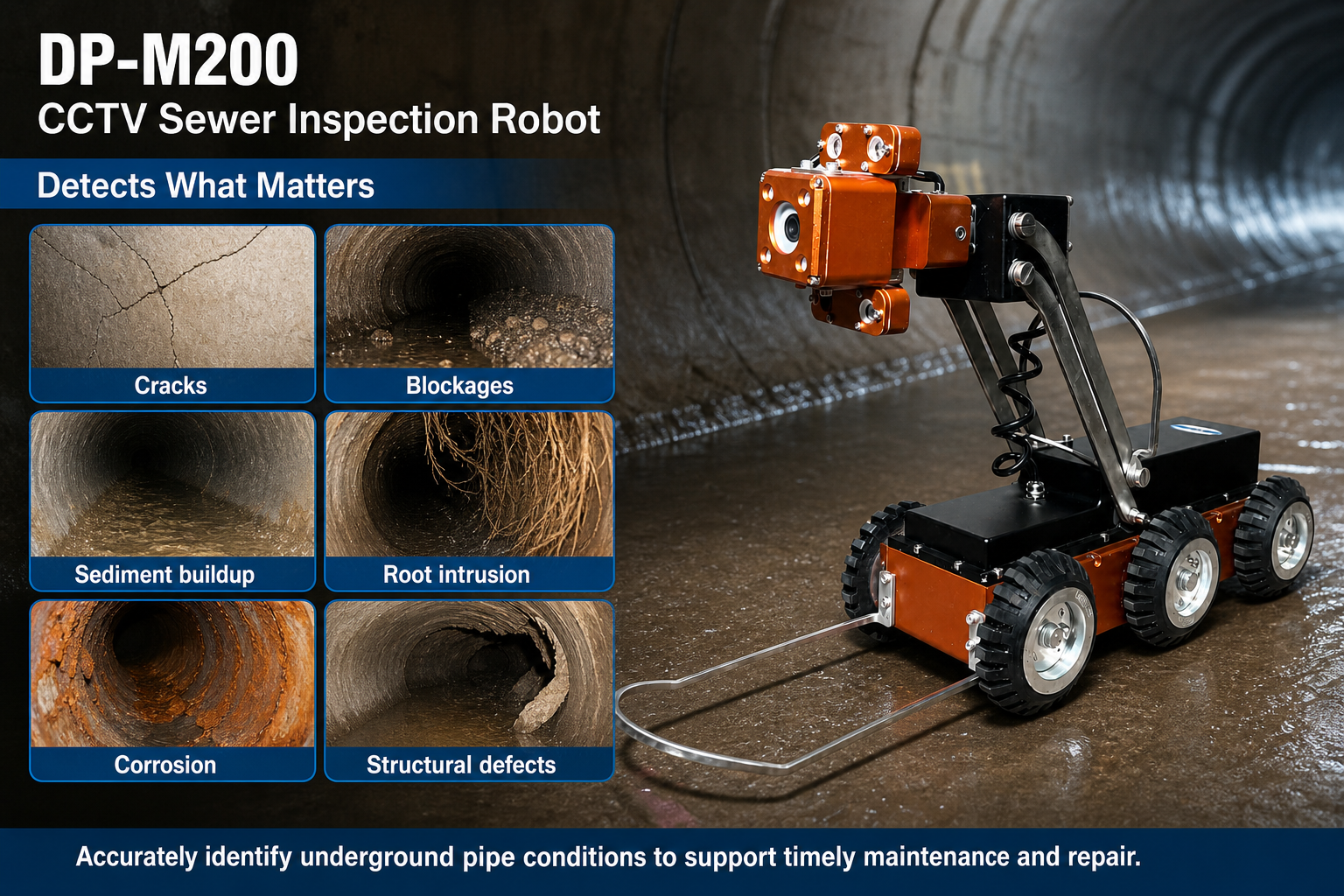
A CCTV survey of a sewer run is a visual condition record. The operator drives a tracked robot through the line while cameras record the wall continuously, and the electronic encoder pins every observation to a metered position. The defect types commonly observed include:
- Cracks — hairline to structural, often the early sign of wall deterioration
- Deformation — ovality and sagging that reduce capacity
- Corrosion and surface loss — on concrete, clay and metal lines
- Sediment and debris build-up — including where the invert has buried itself
- Root intrusion — through displaced joints and cracks
- Joint displacement and gaps — where the line has moved
- Leaks and infiltration — water moving through failed walls and joints
Because every observation is metered, the record is objective: two surveys of the same line in different years can be compared metre for metre.
How a survey run works
- Access — the robot is lowered into the line through a manhole or access chamber.
- Deployment — the control unit is set up at the surface and the run length agreed.
- Inspection — the operator drives the robot through the run while cameras record continuous footage with metered distance.
- Reporting — defects are flagged on the live view, screenshots captured, and a structured report exported with positions, descriptions and risk ratings.
In suitable pipe geometries the survey can be carried out without anyone entering the line — crews work from street level, which removes confined-space entry from the job.
"The camera does not guess. It records what is there, at the position it is there — and that is what makes the maintenance decision possible."
Before you book a survey
Two things make a survey more useful. First, record the dates and locations of the symptoms you have noticed — recurring blockages, settlement, wet patches. Second, confirm the access points you own or have permission to use. Both save time on site and help the team plan the run in one visit.
How long does it take, and what does it cost?
A typical single-run survey of a domestic or lateral line takes under an hour on site, including setup and retrieval. Larger mains take longer per run, and the number of runs depends on the length of line and the distance each deployment covers. Costs are project-specific — pipe size, access and length all affect the quotation — so the practical step is to request a survey with your pipe details.
FAQ
Can a CCTV survey tell me exactly where the problem is? Yes. The robot records distance continuously, so defects are reported at metered positions along the run, not approximate locations.
Does the pipe need to be empty for the survey? Surveys are easiest with flow diverted or low, and silted lines may need cleaning first so the invert is visible. The team will advise before the visit.
Will the ground need to be dug up? Not for the survey itself. Excavation is only considered for repairs — and only after the camera has shown exactly where and what the defect is.
Recurring symptoms are the sign that something below grade is changing. A metered CCTV survey confirms it — before the failure decides the schedule and the budget.